An Advertising Light Box is a framed display that uses internal illumination to make printed graphics, logos, or messages visible. It typically combines a rigid aluminum frame, a translucent graphic face, LED modules, wiring, and a power supply. When electricity reaches the LEDs, light spreads through the box and passes across the printed surface. The result is a bright, even image that remains noticeable in a dim shopfront, trade-show hall, or roadside setting.
As David Hickey, a veteran sign-industry leader, has observed, “Signs are silent salespeople.” That idea explains the practical value of Advertising Light Boxes. They work continuously, without requiring staff to repeat a message. However, visibility alone is not enough. Graphic contrast, LED spacing, viewing distance, ventilation, and installation height all influence performance. A poorly diffused face may show bright spots. A weak frame may distort the graphic.
The mechanism sounds simple. The design is not.
This article will explain how light boxes are built, how edge-lit and direct-lit systems differ, and how light travels through the display face. It will also examine single-sided and double-sided models, energy use, maintenance, and suitable applications. I should admit one limitation: no light box performs perfectly in every environment. Strong sunlight can reduce contrast, while excessive brightness can make a message uncomfortable to read. Good results depend on measured choices, not brightness alone. Readers will gain a practical foundation for comparing products and judging whether a light box suits their location, message, and budget.
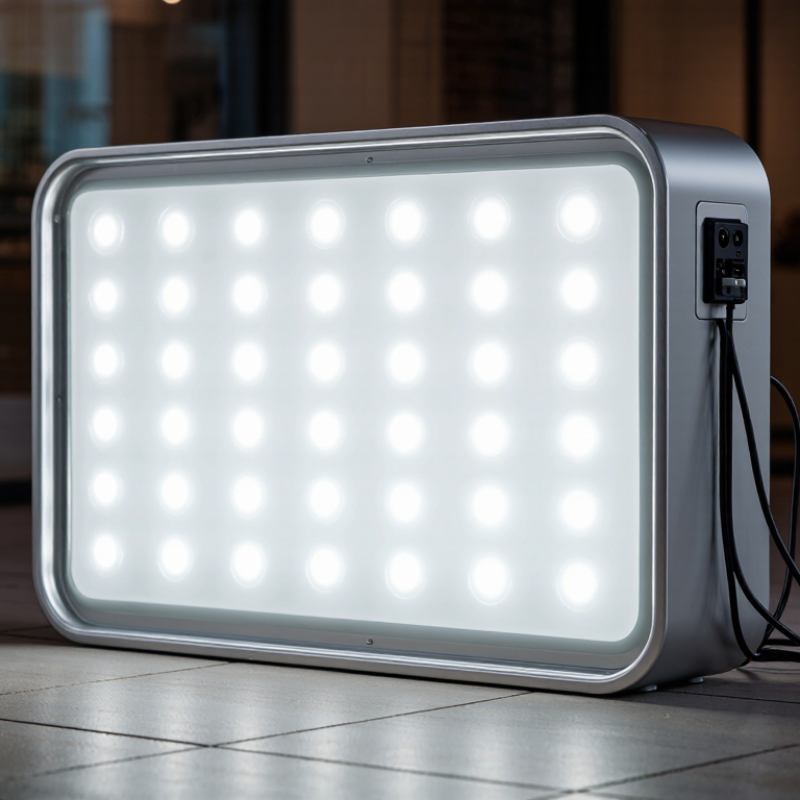
An advertising light box is an enclosed display structure that illuminates printed graphics or digital panels from behind. Its core purpose is visibility. It turns a flat message into a bright, readable focal point.
The box usually contains LED modules, a power supply, a frame, and a translucent face. Light spreads through the face and reveals colors, text, and images evenly. During installation, technicians check brightness, heat, wiring access, and panel tension. These details affect safety and image quality. A poorly spaced LED layout can create bright spots. A weak diffuser can make the message look harsh. The definition sounds simple, but real performance depends on construction and maintenance.
Tips: Choose a diffuser that matches the viewing distance. Test the display at night and under nearby lighting. Keep ventilation and service access practical. Ask for measured brightness data, not only attractive product photos. Inspect color consistency across the full panel. Confirm power requirements before fabrication. This step is often overlooked. For outdoor use, verify weather resistance and drainage with a qualified installer. Even then, conditions can change. Dust, aging LEDs, and uneven exposure may reduce brightness over time.

An advertising light box is an illuminated display unit that places a translucent graphic in front of an internal light source. Light passes through the printed film or fabric, making the message visible and helping maintain consistent brightness across the display area.
The chart shows the approximate illuminated graphic area for common ISO 216 poster formats. Larger light boxes require a larger illuminated surface and typically need more evenly distributed LEDs, diffusion material, and structural support to prevent visible hotspots.
Data basis: ISO 216 nominal paper dimensions. Areas are calculated from the stated width and height and rounded to three decimal places.
What Is an Advertising Light Box and How Does It Work?
Main Components and Materials of a Light Box
An advertising light box combines a frame, light source, diffuser, graphic, and rear panel. The frame usually uses aluminum because it is lightweight, rigid, and resistant to corrosion. Some units use steel for extra strength, but steel increases weight. Clear acrylic or polycarbonate covers the front. Acrylic offers strong optical clarity, while polycarbonate handles impact better.
LED modules provide the illumination. They sit behind the graphic or along the frame edges. A diffuser spreads light across the display and reduces bright spots. The power supply converts incoming electricity into a stable, lower voltage for the LEDs. The U.S. Department of Energy reports that LED lighting can use at least 75% less energy and last up to 25 times longer than incandescent lighting. However, those figures do not guarantee every light box performs equally.
The printed graphic often uses polyester fabric, translucent film, or flexible PVC alternatives. Fabric can reduce glare and simplify replacement. A reflective back panel improves brightness by returning unused light toward the front. Field installers often check spacing carefully because poor LED placement creates visible shadows. Even a well-designed box may show uneven brightness after aging. Heat, dust, weak wiring, or a low-quality diffuser can reduce performance. The Illuminating Engineering Society recommends evaluating luminance uniformity, color consistency, and thermal management during specification. Those details are easy to overlook.
| Component or Material | Typical Material or Specification | Primary Function | How It Works in the Light Box | Common Performance Considerations |
|---|---|---|---|---|
| Frame | Extruded aluminum, commonly with anodized or powder-coated surfaces | Supports the light box and holds the other components in position | The frame forms the rigid perimeter of the enclosure. Aluminum is used because it is lightweight, corrosion-resistant, and relatively easy to fabricate. | Profile depth, corner strength, surface finish, and ease of assembly affect durability and installation time. |
| Graphic Face | Backlit textile, translucent PVC film, acrylic sheet, or polycarbonate sheet | Displays the advertising image while allowing light to pass through | The printed or applied graphic diffuses light from the internal sources so that text, images, and colors appear evenly illuminated. | Important factors include translucency, print quality, color consistency, tear resistance, and ease of replacement. |
| Light Source | LED modules, LED strips, or LED bars | Produces the illumination behind or around the graphic | Electrical energy is converted into light by semiconductor devices. LEDs are commonly used because they consume less power and generate less heat than traditional fluorescent tubes. | Luminous output, color temperature, viewing angle, spacing, rated life, and thermal management influence visual quality. |
| Light Diffuser | Opal acrylic, translucent polycarbonate, diffuser film, or specially designed textile | Spreads light across the display surface | The diffuser scatters direct light from the LEDs, reducing bright spots and shadows and helping the graphic achieve a more uniform appearance. | Diffusion level, light transmission, thickness, and resistance to yellowing affect brightness and image clarity. |
| Back Panel | Aluminum composite panel, galvanized steel, painted steel, or rigid PVC board | Closes the rear of the enclosure and reflects or contains light | The back panel provides structural support and may reflect unused light toward the graphic, improving the efficiency of the illuminated area. | Panel rigidity, weight, reflectivity, moisture resistance, and access for maintenance are key considerations. |
| LED Driver or Power Supply | Constant-voltage LED power supply matched to the LED system, often 12 V or 24 V DC | Converts incoming mains electricity into the low-voltage power required by the LEDs | The driver regulates voltage and current so the LED modules operate safely and consistently. It is normally installed in a ventilated service area. | Rated wattage, input voltage, output voltage, efficiency, protection rating, and heat dissipation must match the installation. |
| Wiring and Connectors | Low-voltage insulated cable, terminal blocks, quick connectors, and cable glands | Distributes electrical power among the driver and lighting modules | Wiring creates the electrical path from the power supply to the LEDs. Proper connectors help simplify installation, inspection, and component replacement. | Wire gauge, polarity, connector protection, strain relief, and cable routing affect safety and reliability. |
| Mounting System | Wall brackets, suspension cables, cleats, standoffs, or freestanding supports | Attaches the light box to a wall, ceiling, floor, or display structure | The mounting hardware transfers the weight and wind or handling loads to the supporting surface while keeping the display correctly aligned. | Load capacity, fixing method, wall condition, access clearance, and local installation requirements should be evaluated. |
| Front Retention Method | Silicone edge gasket, snap frame, magnetic strip, screw-fixed trim, or tensioned textile channel | Secures the graphic face to the frame | The retention method keeps the advertising face flat and correctly positioned while allowing it to be removed for updating or cleaning. | Replacement speed, edge appearance, sealing performance, and compatibility with the graphic material are important. |
| Ventilation and Thermal Management | Vent openings, heat-conductive aluminum profiles, internal air space, or passive heat sinks | Controls heat produced by the LEDs and power supply | Heat is transferred away from electrical components through conductive metal surfaces and natural airflow. Proper thermal management helps maintain stable light output and component life. | Airflow, ambient temperature, enclosure depth, ventilation placement, and driver location influence operating temperature. |
| Typical Light Box Depth | Approximately 50–200 mm for many indoor and outdoor LED designs | Provides sufficient space for light distribution and electrical components | A deeper enclosure generally allows greater distance between the LEDs and the graphic, which can reduce visible hotspots and improve uniformity. | Required depth depends on LED optics, diffuser performance, graphic material, brightness target, and installation space. |
| Typical Color Temperature | Approximately 3,000–6,500 K, with neutral white near 4,000 K commonly used for general signage | Determines whether the illumination appears warm, neutral, or cool | The color temperature of the LEDs influences the visual appearance of printed colors and the overall atmosphere of the display. | Color consistency between LED modules and accurate color rendering are important for brand-neutral image reproduction and readability. |
| Energy and Maintenance Profile | LED systems generally use low-voltage DC power and require periodic cleaning and electrical inspection | Supports efficient, reliable long-term operation | LEDs typically require fewer lamp replacements than fluorescent systems. Maintenance mainly involves cleaning the graphic and diffuser, checking connections, and replacing failed modules or drivers. | Actual energy use depends on illuminated area, LED density, operating hours, dimming, and power-supply efficiency. |
An advertising light box is a framed display that uses LEDs to illuminate printed graphics. Its operation begins with an electrical driver, which converts incoming AC power into stable DC power. The LEDs then produce light through semiconductor materials. In edge-lit designs, LEDs send light into an acrylic light guide. Tiny extraction patterns redirect that light across the panel. A diffuser softens bright points and creates a more even surface.
Direct-lit models place LED modules behind the graphic. Their spacing, diffuser distance, and optical angle affect brightness uniformity. A printed film or fabric controls the visible message, while the frame holds every layer in alignment. Color temperature changes the display’s mood, and color rendering influences how accurately images appear. Small details matter.
The International Energy Agency reported in its Energy Efficiency 2023 analysis that lighting accounts for about 15% of global electricity consumption. The U.S. Department of Energy also states that LED lighting can use at least 75% less energy and last up to 25 times longer than incandescent lighting. These figures support LED adoption, although real savings depend on operating hours, driver quality, and maintenance. A poorly ventilated box may lose brightness as heat accumulates. Uneven diffusion can also produce visible shadows. The result is not always perfect. Technicians should measure luminance, inspect connections, and review energy data after installation.
An advertising light box uses internal LEDs to illuminate a printed graphic. The light passes through a translucent panel, making colors appear brighter and easier to notice. Most units include an aluminum frame, a diffuser, and a replaceable graphic.
Brightness alone is not enough.
Edge-lit light boxes place LEDs along the frame edges. They are slim and suitable for walls, counters, and narrow displays.
Backlit boxes position LEDs behind the graphic. They need more depth but usually provide stronger, more even illumination.
Fabric light boxes use a tensioned textile graphic. The fabric slides into a silicone-edged frame, creating a clean surface.
Wrinkles can still appear if installation is rushed.
Snap-frame light boxes use hinged profiles for quick graphic changes. They work well in retail areas, exhibitions, and indoor directories.
Outdoor light boxes require sealed housings, weather-resistant materials, and suitable electrical protection. Check the IP rating and power requirements before installation.
A very bright display may attract attention, but it can create glare or uneven hotspots. Careful diffuser placement matters.
In practice, measuring the wall twice prevents costly fitting errors. The first design choice is not always the best one, especially when viewing distance changes.
Temperature, maintenance access, and graphic replacement should also influence the final selection.
An advertising light box is a framed display with internal LEDs, a printed graphic, and a translucent front panel. Light spreads through the panel, making images visible in dim or crowded spaces. Edge-lit models use side-mounted LEDs, while direct-lit models place LEDs behind the graphic. Each design affects brightness, thickness, and maintenance.
Common applications include retail windows, shopping malls, exhibitions, transport areas, restaurants, and reception counters. OAAA reported that United States out-of-home advertising revenue reached about $9.1 billion in 2023. This indicates continuing demand for visible, location-based advertising.
Grand View Research estimated the global digital signage market at approximately $26.76 billion in 2022. Light boxes remain useful where simple, static messaging is more practical than screens. They need no software. They also produce no screen glare.
Brightness is not everything. Measure the viewing distance, ambient light, and available wall depth before choosing a unit. A bright box can look harsh near a checkout counter. A weak one may disappear beside a sunlit window.
Choose a color temperature near 4,000–6,500 Kelvin for clear graphics, but test the actual print material. Dark colors often absorb light and appear uneven.
Frameless designs suit premium interiors, while snap-frame models support faster graphic changes. Check LED lifespan, heat control, power consumption, and access for maintenance.
A perfect specification can still fail on site. Poor installation alignment remains an underestimated problem.